May I have your attention?
How the evolution of YouTube and its integration into news feeds helps fuel the anti-trans machine.
What is news?
Partial scrape of the likes and comments of YouTube videos over a three year period (n=5,409, approx 74% of data).
When I first started this series, YouTube and Facebook videos were only a small portion of the Google News feed. Since then, Google has elevated the platform and been open about liberalizing the criteria for being indexed as news. So when last time I noted at the bottom that YouTube was a steadily increasing chunk of the news media being served to my bot over a thousand or so days, I naively assumed the bulk of this would be your “middle of the road” outlets like NBC, MS NOW, or up until recently, CBS News. According to Pew, the majority of Americans when surveyed report that they use YouTube as a primary source of news, and a significant portion prefer “independent” channels over large name outlets. My assumption about liberal centrism winning the day was dead wrong. And I wanted to know why.
YouTube is where the worst elements of gamification collide with our information ecosystem. Up until recently, YouTube was also one of the only places you could upload long-form video content for free, and it’s one of the most heavily monetized. Unlike TikTok, which has been siloed in its own digital universe, YouTube is designed to be embedded and function as a part of other sites. This serves as a jumping-on point for users to get onto the main site. Everything about it is designed to draw users in, and once they’re there, to keep them there.
Before we talk about algorithmic manipulation, it’s worth admitting that it is very hard to say exactly when the wall between news and other types of media collapsed. Wikipedia traces the first opinion column as far back as 1690. The distinction between current events and opinion went largely unmarked until the 19th century. During most of this time, the perceived legitimacy of a given outlet was largely artificially created, based on who had the means to distribute printed paper, and was therefore able to garner an audience. I imagine that it’s not an accident that modern laws against libel and slander emerged primarily after the adoption of the printing press. Nevertheless, for a long time there was a substantial, albeit misguided, perception that the popular press was more reliable and provided a more factual accounting of events than say, Usenet in the 1980’s, Livejournal and MySpace in 1990’s, or eventually Facebook in the mid-2000’s.
Ben Shapiro’s Facebook feed in Google News results.
Much like we’re seeing with generative AI, a lot changed in a very short amount of time after social media really took hold. Of the major presently active social media sites, YouTube first launched in 2005. Facbook started In 2006 initially at Harvard, just around the same time as Twitter’s initial launch. Facebook had over a billion active users by 2013 — for scale, this is more than 1 in 10 people on Earth. By 2017, the year that Substack launched as a subscription service to rival Medium and Patreon, Facebook boasted 2 billion active users. At this time, Facebook and Youtube competed for the most frequently visited websites in the world outside of Google. The following year in 2018, Youtube started showing up in Google News results.
Although there have been many, one of the first major social media scandals to garner international attention was around 2015-2018, when the robust user-data Facebook had harvested was used to manipulate the election in the Cambridge Analytica scandal. While Facebook and YouTube have battled it out for dominance in global rankings, both have played growing roles in the distribution of media, and by extension news. Even outside of Google’s own content distribution, YouTube is the largest digital video platform beating out giants like Disney, Netflix and Hulu. This offers an advantage for long-form content, but short term content has a new importance in the information ecosystem. In addition to direct algorithmic manipulation, short form viral content is also easy to produce and discard, which is likely why so many aggregator websites like MSN News serve garbage which is “no longer available” when you go to retrieve it. These then become sources for social media posts, which then become false primary sources for unscrupulous editors.
Social media platforms are increasingly the biggest deciding factor in what news gets served and when. The right understands that it has to control the rhetorical sphere, which is why Trump set up his own social media site after the 2020 election. Although nearly defunct at one time, it is now the platform on which the president makes all official announcements.
Social Media is an increasing portion of the news feed
Although I had set out to track the news in its more traditional sense, and the evolving linguistic drift myself and other researchers had been noticing, what I also found was a snapshot of how social media and the app-driven information economy impact what is served as news. In many cases, the URL served reveals information about the source. For Substack articles, the IDs of specific users are often visible, including hashes that validate them as being generated to send to a specific person, like a gift link. This is then reproduced in the News index, suggesting they were scraped directly from social media.
A small subset of 18 entries show the top-level domain as Google itself. Parameters after the main URL show the real sources, alongside tracking tokens, and redirects. The example below shows a result from the Catholic News Agency/EWTN News, which somewhere along the chain was served to someone’s Feedburner account. It was then shared from Feedburner, and rescraped. It’s unclear if this was manually done but regardless of the exact process, this goes to illustrate that what people often perceive as a straightforward aggregator from reliable news sources is actually a series of recursive loops which can be gamed. When fed to Gemini, it also shows some originating from HubSpot, which EWTN uses to manage communications.
Screenshot of RStudo hovering over a URL which contains multiple tracking tokens.
Enter the algorithm.
Algorithmic social media is often misunderstood as being a feature for improving the experience of the end user. There are ways in which that’s accurate: personalized recommendations are for obvious reasons more satisfying for users. They allow us to discover content aligned with our interests, and offer new sources of content based on the likelihood we’ll enjoy them. Algorithmic content distribution is an invisible tour guide helping us navigate the infinite amount of information we have at our disposal.
However, the driving force behind most algorithmic content curation is simple monetization. Commercial social media platforms are predicated on the notion that communication is more important than what is being communicated, whether it’s true, or how often it’s said, so long as someone is saying something, and that something is keeping users engaged. Ad revenue in particular means that developers are incentivized to maximize the amount of time users spend on their sites, which is partially why many social media sites like Twitter/X have invisibly penalized posts with links in them. Taking users to a new site deprives the app of a user’s attention, which deflates the numbers used to pitch to advertisers. This has a significant effect on the news, because the method of distribution changes the behavior of news media consumers substantially. The merger of social media and news also imports with it a host of technologies we’ve all become familiar with, but haven’t perhaps given too much thought to the origin. To keep users glued to their phones, developers of social media sites turned to casino technology. While people like Tristan Harris, a former Google Design Ethicist claimed this emerged accidentally on a Medium post, the evidence is fairly damning. In the same article, cultural anthropologist and associate professor Natascha Schüll had this to say in the Guardian:
“These methods are so effective they can activate similar mechanisms as cocaine in the brain, create psychological cravings and even invoke “phantom calls and notifications” where users sense the buzz of a smartphone, even when it isn’t really there.
“Facebook, Twitter and other companies use methods similar to the gambling industry to keep users on their sites,” said Natasha Schüll, the author of Addiction by Design, which reported how slot machines and other systems are designed to lock users into a cycle of addiction. “In the online economy, revenue is a function of continuous consumer attention – which is measured in clicks and time spent.”
While I would like to believe the landscape we live in today is as incidental as Harris wants us to believe, simply put: I don’t. Schüll is an expert on the gambling industry and the history of manufactured addiction, and her case is as compelling as it is concordant with the timeline of scandals and developments in advertising surveillance technology which exploited these phenomena to embed proprietary platforms into our lives and culture. We’re seeing echos of this with the force-feeding of generative AI.
Variable rewards add anticipation, and reinforce behavior that is perceived to increase the chance of eliciting more notifications full of what’s largely experienced as positive feedback. This may also be driving up our desire for those rewards, in turn increasing the dopaminergic “payout”. The ultimate takeaway from Meta and Google/Alphabet’s exploits in reshaping the delivery of information is that this problem is not theoretical, but a known quantity.
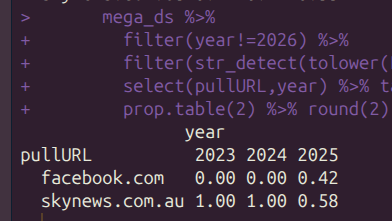
Google News is a hybrid of many types of media, costumed as an information repository. It has also started to include all sorts of social media posts as of late. In fact, for corporations like SkyNews Australia, Facebook posts account for almost half of the entries in the index. This only started in 2025, and likely represents a shift in the company’s SEO strategy. As of today, entries from Sky News Australia are overwhelmingly Facebook posts rather than originating at the SkyNews website at a ratio of 67:6, or roughly 11x more frequently.
I had admittedly initially failed to replicate this outside of the scraper (I have since replicated it multiple times manually). But as soon as I’d stopped poking and was instead trying to find out information about the war in Iran, a segue window opened midway down the page showing “What’s happening on X”. A little later, one only dedicated to reels and short form content showed up. And this is how experimental features work. Google is always tweaking the interface, and adding ways to inject short new types of media. The same is true for every major “portal” while every platform competes to become everything for everyone. They claim it’s to “stay relevant”. This has some unexpected consequences, though, like when after an international tragedy pushes JK Rowling’s Twitter/X into the “news” feed, or as happened more than once, LIbsofTikTok It is also how Grok got indexed by the bot as “news”.
Grok in the Google News feed
One of the unexpected things I hadn't anticipated in just focusing on YouTube results within the larger dataset I've previously written about was just how much viral video content is produced by only a handful of outlets in the UK and Australia. And I thought it was a mistake, so I asked people. And people started telling me "oh that happens to me! it's awful, what the hell is up with Australia?"
I was even more confused that Fox had a smaller footprint. But Fox has its own video distribution system. Of the extraordinary number of pieces of media Fox has put out about trans people that have then been indexed by Google News, roughly 10-25% of them are connected to video clips hosted on the Fox News website. While they distribute on YouTube, it’s not a primary distribution channel. This is not true for the other two outlets, which pump an extraordinary amount of content onto the platform. The YouTube API reports Fox has served 135,519 videos. Sky News Australia, 216,138. GB News is tiny, but it boasts 84,787, not nearly as far afield from Fox as it ought to be given their relative sizes.
Both GBNews and Sky News Australia are rising rapidly in YouTube rankings. Press Gazette, a sort of meta media outlet that tracks trends in the news ranked the news outlet as the 2nd fastest growing outlet on YouTube in 2023. While not the top in Australian TV news, in many rankings, it is in the top ten of all channels on YouTube and it is gaining steam.
Short form video content
Of course, there are an ever-diminishing number of media conglomerates that control more or less all information on the planet. While this has been largely true for the past fifty years, the rate at which it has accelerated in a world dominated by social media is almost incomprehensible. The implosion of the Warner Brother’s/Netflix merger comes just as Larry Ellison’s Oracle becomes the domestic answer to ByteDance, the company behind TikTok.
What shows up in video form on Google News is actually quite telling. Amidst a sea of YouTube videos and a small smattering of Facebook and Instagram reels, TikTok never appears in the dataset, and appears to have been blacklisted from the news index. I have nothing to support this but think it’s likely that as Ellison controls more of the functioning of the site domestically, we may see TikTok in the “news” tab soon, although this may be hampered by the perceived rivalry between the Oracle owner and Google. Regardless, for as much as I personally find Tiktok sensorily assaultive, it is increasingly where people get their information (for better or for worse) and it is difficult to make the case that Facebook can be trusted but TikTok cannot.
Facebook entries on Google News are also largely video content, which is served occasionally embedded inside the News results. Outlets are always experimenting with the best way to serve their content that leads to engagement, and Facebook is one of the largest social media platforms in Australia by a large margin, even outpacing YouTube in some specific metrics. (YouTube is overwhelmingly the most visited platform on the internet next to perhaps Google, visited at roughly 5x the frequency of Facebook.)
YouTube makes up for around 3.5% of all unique URLs in the dataset for the year 2023, making it one of the most prolific “news” sources on the internet that year. After removing duplicates and grouping by top-level domain, the top 3 domains are Yahoo, MSN, and YouTube, with YouTube in 2nd. By comparison, this dwarfs both Fox News and the Daily Mail.
Initially focusing on more mainstream keywords and looking specifically at YouTube without a regional specifier, inexplicably, the channel “Forbes Breaking News” comes out at the top in some cases. While it’s hard to know what to make of this, it matters that this shows a different information ecosystem.
On Forbes, the headlines are mixed. Alongside some blandly neutral content, the majority are about manufactured sports controversies and feature a range of conservatives like Jim Jordan, Nikki Haley, Riley Gaines, Ron DeSantis, amongst others. These are predictably grotesque, as are vindictive culture warrior titles like “Dan Crenshaw Claps Back At Raul Ruiz Over Transgender Studies.” The next two are GBNews and, again, Sky News Australia. If outrage is the most vaunted currency on YouTube, the far-right will always win on sheer numbers. This has accelerated as a result of YouTube removing trans people as a protected group in the company’s hate speech policy.
Using the most common keyword (“transgender”) and the most inclusive region category (“all regions”), the YouTube domain (approx 3.2k) beats out the Fox News wesbite (approx 1.1k) by a margin of 3:1. While Fox News has produced more trans-related content than any other news website, it’s primarily UK and Australia outlets that dominate the video results when Google shows these in the results, and this is reflective of the fact that YouTube accounts for most of these results. YouTube functions differently than other parts of the internet with unique stars and idiosyncrasies.
But of course this is also tricky just looking at YouTube itself. While “transgender” is the most common keyword in aggregate, this is now true broken down by search term and outlet. Below the videos are grouped by year, channel, and keyword. The channel that has shown up the most under a single search term is GB News. The keyword: “gender ideology.”
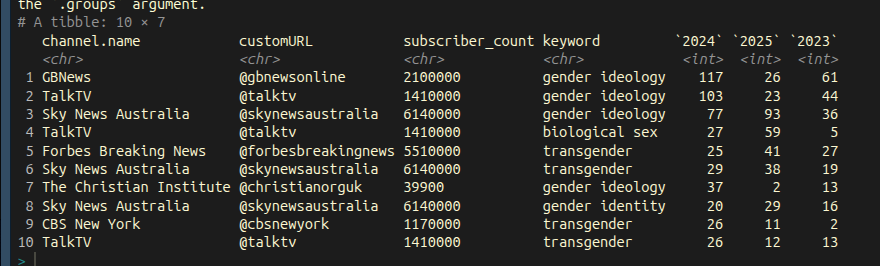
While it may make intuitive sense in some broader context to have the video channels of news outlets show up in the news results, virality is a terrible indicator of veracity. That one channel has garnered over 2.6 billion views across the more than 84k videos on offer, earning them 2.1 million subscribers. While the anti-trans side has channels with billions of users to mobilize, LGBTQ+ specific channels like PinkNews have 355k subscribers and 3.3k videos only appeared 7 times, 2 of which were duplicates. The vast majority of LGBTQ outlets were never served as YouTube links in Google News during the more than 3 years the scraper bot has been running. GLAAD, which hosts the annual LGBTQ+ Media Awards has only 61.7K subscribers and never appears. The Human Rights Campaign has 95.4K, and appears twice across roughly a thousand days, compared to the Daily Signal who appears 6 times and has over a million subscribers. The largest platform trans people have on YouTube is through Individual influencers with hundreds of thousands of followers. They too are absent, but Matt Walsh and Michael Knowles are not.
While Facebook’s misdeeds are far more widely known, YouTube has also attracted well-earned criticism for disproportionately serving right-wing content. As Robert Evans explains, researchers have been able to document this extensively in both the gray and professional literature, even systematic reviews. Part of this can be understood as a side-effect of the self-reinforcing nature of recommendations engines. But once a user is on YouTube, they’re more likely to see content that has been engaged with by other users, and sadly nothing gets people engaged like controversy. At the end of the day, even if it wasn’t designed to do this, YouTube can pull you down some dark rabbit holes. And many who find themselves down such a hole stay there. A much larger portion of those people than it ought to be make it their whole worldview.
To understand YouTube’s menace to public health we can look to a parallel process visible in the “Facebook Papers”. These are an internal cache of documents that show Facebook’s selective enforcement strategy and live testing of various algorithmic tweaks to the news feed. Amnesty International makes damning observations in their own report on the role of Facebook groups in the genocide in Myanmar. Wikipedia now offers a comprehensive overview.
Bizarre grouping shows GB News and Sky News Australia pumping out identical rage-bait at a nearly identical clip.
Channel statistics pulled using the tuber R package
Sky News Australia makes no attempt to hide how they feel either, with video titles like “There are serious dangers that come with the so-called gender-affirming care and trans ideology being pushed on impressionable children.” This last is a hit piece on Jazz Jennings, with panelists picking apart her transition, her life, and most frequently, her appearance. That video has 7,322 comments and more than 877,000 views. The channel has 6.14M subscribers at the time of this writing, and has over 21,000 likes.
But there’s a reason it’s these specific outlets. The current CEO of GB News, Angelos Frangopoulos, was previously CEO and managing editor at Sky News Australia, as recently as 2018. Angelos sees conservatism as being under attack and has, for example, defended a GB News host for saying that supporting LGBTQ+ people is supporting pedophilia.
Sky News Australia broke from Sky News in the UK in 2016 when Sky News Australia was purchased by News Corp, the former coporate owner of Fox News. Both Sky News Australia and Fox News are owned by the Murdoch family. Sky News Australia is rumored to be changing to News24 but there had been speculation in 2024 that it was instead going to rebrand to “Fox News Australia,” although that does not appear to be the case anymore. Nevertheless, the three outlets can all be understood as being ideologically not only aligned but in many cases more or less identical. The Guardian noted in 2021 that Sky News Australia is a favored outlet of Alex Jones and has demonstrated a significant turn towards the right.
While it’s become popular amongst people like Matty Yglesias to blame trans people for the Democrats losing electorally, the blame sits squarely in a much more obvious place. The rise of News Corp’s most extreme conservative tendrils corresponds with what is ultimately a massive boom in disinformation and salacious media presented as “honest” news. The “silent majority” narrative that Yglesias is flirting with— which suggests that the average person is far more conservative than they let on but are all quiet about it due to social pressure as they perceive themselves to be in the political minority— is actually a reproduction of the conspiratorial frame adopted by News Corp and Fox, and by extension Sky News Australia, have been relying on to recruit new audiences.
The inclusion of social media also brings with it a host of practices that haven’t been penalized quite as vigorously as search engine cheats. The TalkTV YouTube channel appears 147 times when restricting to the three major keywords (transgender, biological sex, and gender identity) of the original design. And there are certainly loads of anti-trans content, but many of these are false-positives. Below is an example of “description stuffing” where irrelevant information is added to the video description to reach a larger audience. While many of the channels are guilty of this, TalkTV is egregious even by YouTube standards. While it has been scrubbed from the video metadata, the scraper captured the description at the time of the initial post.
“description stuffing” shows keywords summarizing every top story of the day to generate clicks.
The description was then located as the current description for an entirely different video.
While deceptive practices like the above make it hard to quantify the exact amount of content that is actually a relevant result, these aren’t universal practices. Far-right British outlet GB News was served a total of 74 times across the three main keywords. Every one of those entries is viciously anti-trans, ranging from railing about trans people and breastfeeding to naming and shaming private citizens. Many of the video descriptions insinuate outright false claims to generate clicks, such as one labelled “‘transgender’ TODDLERS to have gender treatment.” Rather than being an error, this is the primary claim of the video as the longer description contains the same claim: “Andy Williams reacts to reports that the NHS is giving nursery-age children gender treatment.”
The comments are as revealing as they are difficult to read. Three of the 157 comments on the video express surprise that the “treatment” is being offered, as they “thought blockers been banned.” Others not included below, but available in the video comments section as of today, include demands for arrests and blame trans young people for the long NHS waiting lists. In all of this, there is a single comment (0.63%) that asks whether this is perhaps an inaccurate description. I shouldn’t have to say this, but puberty blockers have been banned in the NHS for gender dysphora since 2024, and there has never been a protocol anywhere in the world that administers such medications to toddlers. The data being referenced are likely initial counseling referrals.
I promise I didn’t change any of this metadata, that is really the username of the person who left that comment.
Outrage really does sell on YouTube. When looking at average likes per video, comparing two comparable samples from 2023 and 2025, negatively valenced search keywords as served in Google News outperformed positive or neutral keywords every time. In 2023, “transgenderism” had an average of 5977, compared to 999 for “transgender.” By 2025, "gender confusion” outperformed the others in terms of mean likes, with “gender confusion” on average getting 4199 likes. “Transgender” only got 477.
As I described the problem on MSN, the vapor issue, where articles make a splash for a few days and then disappear, persists on YouTube as well. They offer predictably incendiary claims once pushed to users but now hidden from memory, the impressions they left and the rhetoric they pushed no doubt still persisting nevertheless. This includes videos with titles like “"Trans" Person Exposed His Junk To High School Girls” and “The Adult 'Gay Baby', A Trans Kitty Cat & The Loud Shrieking of The Left!”
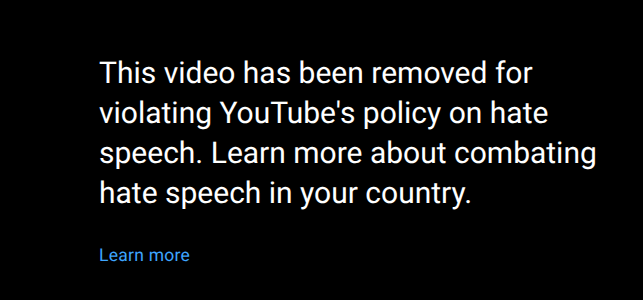
In rare instances, videos like “Pushing Gender Confusion and Drag on Kids Isn't the Left's Goal. The Endgame Is Far Worse” have been removed by the platform itself. The fact that it was too much even for YouTube didn’t stop it from being served as “news” at the time on Google News, to anyone searching “gender confusion.” I added this term in the second wave of RSS feeds to see what results are served to trans-agnostic parents who might be using language they’ve heard elsewhere. All of the examples here are real search results that were served at one time. Amazingly, this includes ones with obvious attempts to circumvent moderation, such as one containing the phrase “SL3EP!NG with transgender.” While I’m sure this was far from a top result, it was nevertheless served to the main scraper under the search term “transgender.”
Social media engagement clearly drives the rankings.
But ultimately, what drives YouTube, and by extension, how things are ranked and shown on Google News and every other major platform is engagement. Engagement is defined by a variety of metrics in digital marketing, but since there’s no “retweet” on YouTube, likes and comments are the two biggest drivers. If you have a million subscribers but no one cares about your video, it may still get served but it won’t float to the top. But, if you’re the Telegraph, whose cumulative views on YouTube are just shy of 4.5 billion, and Jordan Peterson, with 6.1 million followers on Twitter/X, when you tell everyone that Canada is turning into a communist hellscape full of gender radicalism run amok, you can get a lot of engagement. A lot. That video was viewed over 5 million times with a staggering 153,614 likes and 22,127 comments. Simply put: when no one speaks up for trans people, and our opponents are some of the loudest voices on the planet, it’s not difficult to figure out who’s going to be heard above the din. It isn’t us.
Not a single LGBTQ+ outlet was in the top 20 or the top slot for any year on any specific keyword. Most were vocally anti-trans, and skewed UK and Australia. The first neutral outlet is in 15th place, NBC News.
Negatively valenced keywords are much more heavily represented in the data, which begs two questions: is this a function of more YouTube videos being returned per keyword based on a dearth of print media, or is it that anti-trans outlets, and therefore the keywords which elicit them, are more prolific? I would argue that the answer is probably both but also that anti-trans niche groups form on sites like YouTube because they reward interacting with the site. With other platforms like TikTok being more popular with liberal/progressive users, and TikTok being oddly absent from the listings, this naturally pushes YouTube to the top. And it brings all the ingredients of a successful video with it.
2023 was the year of “transgenderism”, and the massive spike correlates with a wave of threats against institutions providing gender-affirming care.
Much of the explosion of stories in 2023 can be directly traced to the harassment of Dylan Mulvaney for the crime of getting a beer can in the mail.
Epilogue: what is news?
One of the more difficult to parse changes in the past few years as it pertains to tracking shifts in the news has been trying to find the line in the sand between what actually constitutes “news” and what is, for lack of a better way to say it, everything else. Social media has complicated this enormously, with the ability to break stories before they’re picked up by wire services like the Associated Press or Reuters. Wars, major disasters, and large outbreaks of contagious disease are today first reported by ordinary people using a mobile phone far before anyone starts to put together a story. This was fantastic, at first. The democratization of media put the means for mass communication in the hands of everyone with an internet connection.
But for however much it has empowered the average person, this capability is still largely dependent on infrastructure. Increasingly, those who control that infrastructure have figured out new ways to consolidate power away from the end user. Even when plausibly unintentional, our continued gamification of reality has unintended effects, and it renders most of the heuristics we use for determining the veracity of information fairly insolvent. This coincides with a global propaganda war waged on several fronts, using search engine optimization, large language models, and paid advertising as weapons against minority groups with no social or economic capital with which to push back.
More to come…
Still looking for something to read? check out the others in this series:
A little about methodology and limitations…
I have been transparent thus far that there are limitations to these data: the first is that they’re susceptible to the very targeted advertising Google uses to personalize my results. The second caveat is that these data are based on a series of google alerts, which use “as it happens” settings and varied regional settings and keywords of different valences to get a broader cross-section of the news index. I describe the whole tortured process in the very first blog post, although I’ve made many improvements to the process since. There are a handful of things I cannot readily explain, but may have to do with the age-verification system implementation of various platforms as they’ve evolved due to largely misguided or outright harmful (see: KOSA) legislation. Oddly, for example, YouTube has never been served to the bot using the UK region specifier. I have no explanation for this. Anyone who uses a European VPN will see their search results change frequently and with sudden, seemingly random effects.
With the outpouring of interest in these data, I’ve started to recreate the process using slight variations to see how this impacts the results. I’m attempting a version in the future which will grab the top splash pages instead of using the method described above, to see if I can replicate what most users see first. That being said, as the multi-keyword, multi-region design shows, what is returned on ostensibly the same topic is massively influenced by the user. Rather than ascribe ill-intent based on the valence of the keyword, we would do well to remember that “gender ideology” is a term now being laundered by corporations like CBS. It’s not unreasonable for someone who does not know trans people to search these without malice, and be plunged into a rapidly radicalizing ecosystem.
Realistically, the easiest way to replicate this for yourself is to use the terms coming out of the White House. “Gender Ideology” was first popularized by the Vatican to besmirch feminism, but has enjoyed a resurgance as of late appearing in executive orders and state laws. It has also begun to appear without scare quotes in media outlets like CBS, which shouldn’t be surprising given the new leadership. Nevertheless, over the course of a day I searched the term about ten different times. Each time, the top keyword was the one I’d initially assumed was a mistake when I saw it in the fresh data from the scraper. Ordo Iuris, formally known as the Ordo Iuris Institute for Legal Culture is a far-right law organization from Poland, similar to the ADF. They were in part responsible for the creation of “LGBT-free zones” in Poland.” In that same search, Ben Shapiro’s personal facebook appeared in the news section as the third result on the second page. While many of the most bombastic entries in the dataset are clearly at the back of search results, it would be a mistake to assume this is always the case. This will likely increase in frequency as Google continues to integrate social media into their news index.
There are of course other consequences of using virality as an indicator of newsworthiness. Purely by accident while researching this installation in the series, I found a string of hits where a known exploit found its way into the index. The exploit, and the small crime spree in 2024 is explained here. What’s notable is that these were on the three main keywords, and used poached text from other sources., including an Xtra magazine on the Cass Review which appeared of all places on chicagocatholic.com. The article title is real, you can read the story here.
In each successive installation of the analysis series, I’ve added more information about my process. For the whole series, see below:
For background on the project:
