Welcome to the anti-trans outrage factory
Two years later…
When I first wrote “Anatomy of a moral panic” in February 2024, I had only a faint glimmer of what was to come. While I knew that as a country we were on the precipice of authoritarianism, I was assured that my great fear that this would accelerate during the upcoming election — with propaganda about trans people ultimately forming a primary rhetorical cudgel for fascism, was an overreaction. I was also assured he wasn’t going to win or that it wouldn’t make a difference.
But the astronomical rise in stories about trans people that I’d collected over the previous year told a different story. This massive, messy dataset was brimming with increasingly vile headlines that only seemed to metastasize with time. 2023 was nothing compared to 2024, and 2025 showed no signs of slowing down. Two years later we know how the story turns out. Our annihilation has become a central organizing principle of the Republican Party.
Every time I think I’ve scratched the surface of what I’ve come to call “the outrage factory”, I lose an entire weekend combing through stacks of awfulness that takes a whole bank of monitors to see. The following are my newest notes as I try and make sense of how we got to where we are. How they manufactured the illusion of a dangerous all-powerful enemy out of a tiny demographic with no political influence, financial resources, nor social capital.
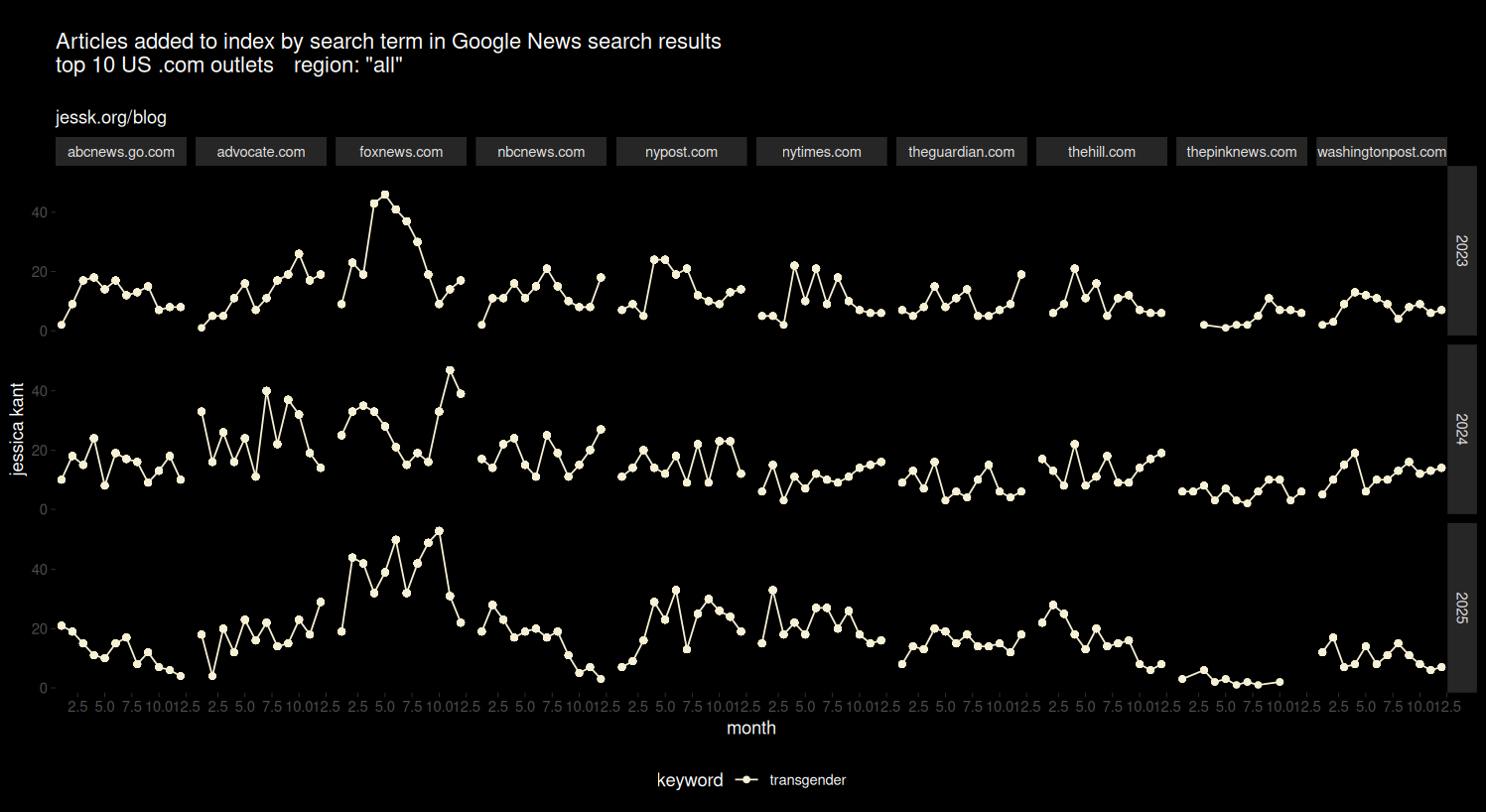
Fox News publishes more about trans people than any outlet in the US — including LGBTQ+ publications

To create an enemy, make them seem ubiquitous
Restricting to the six conservative outlets I cited as indices of the rising tide of anti-trans sentiment, and only using the 3 mainstream keywords which made the core dataset: 3,453 unique URLs were added to the index during the time the bot has been running. 1,787 are from Fox News alone. In every day of the year since 2023, Fox News has run more articles referencing transgender people than there were days in the year.
This is equally true for the UK, where both the Telegraph and the Daily Mail outstrip even the BBC by 2-5x in any given month.
(Note: using the expanded dataset, 2,157 unique URLs were recorded from foxnews.com. For most of this post, I focus on the core dataset, as Fox News’ reliance on A/B testing can give multiple hits for the same article.)
Controlling language
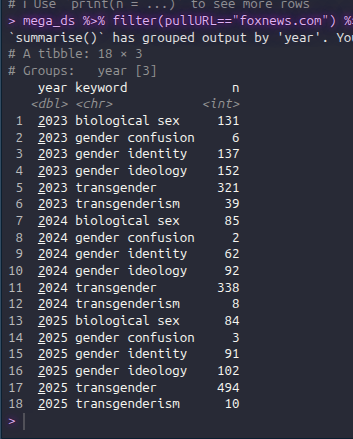
While the 3-keyword design of the original scraper only provides a sample of the links served via RSS based on specific keywords, the design did pay dividends as can be seen below. With respect to the initial question surrounding linguistic/discursive drift, patterns we all experienced in real-time are immediately visible. While the term “transgender” produced far more hits in general, filtering those out shows a background process of updated style-guides and competing opinions about which keywords to emphasize related to “biological sex” and “gender identity.”
The linguistic drift I’d talked about in “Hate in a post-information age” has come full circle, and it was the word “transgender” itself that was hurled as invective in the 2024 election that happened 8 months after publication. How did this happen? Does it even matter?
A large part of destigmatization of transgender people and our lives hinged on cleaving apart the discussion of “sex versus gender” from our basic existence as transgender people. Put most simply, for the briefest possible moment in time rather than providing qualifiers or over-emphasizing assigned sex at birth or equivocating on whether we know we are who we say we are, the word “transgender” became a proper adjective.
And as small as it may sound, the strategy to undo this progress therefore hinged on emphasizing sex and gender strategically at different times. Wherever possible, many outlets would add both of these pieces of information, such as: “[she] identifies as a woman but is biologically male.” Whereas “Sophie is a transgender woman” immediately communicates all the information the average person needs to know, and communicates those other pieces of information just as effectively without emphasizing their primacy, combining these has the opposite effect. In the previous example, everyone knows “Sophie” was assigned male at birth— it’s communicated by saying she is transgender the same way saying that someone is short communicates that they are not tall.
Adding all three of these words appears to have become the norm again in outlets like the Washington Post, (eg: “she is transgender, and identifies as a woman but is biologically male.”) emphasizes subjectivity, delegitimizing the concept of transgender people in the eyes of many who had started to acclimate to the idea. Words are powerful.
The Daily Mail provided more coverage (derogatory) of trans people than any other outlet in the UK
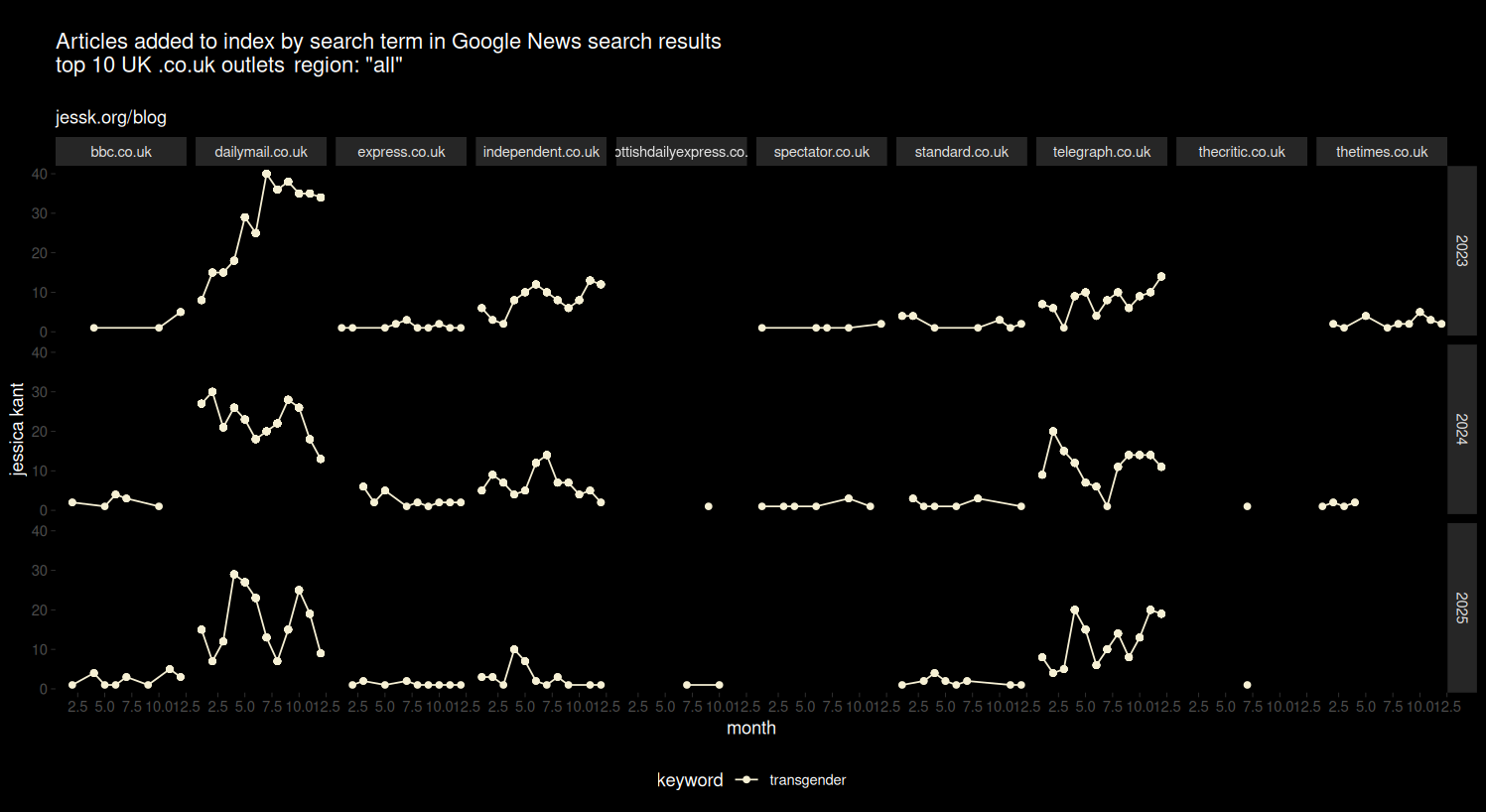
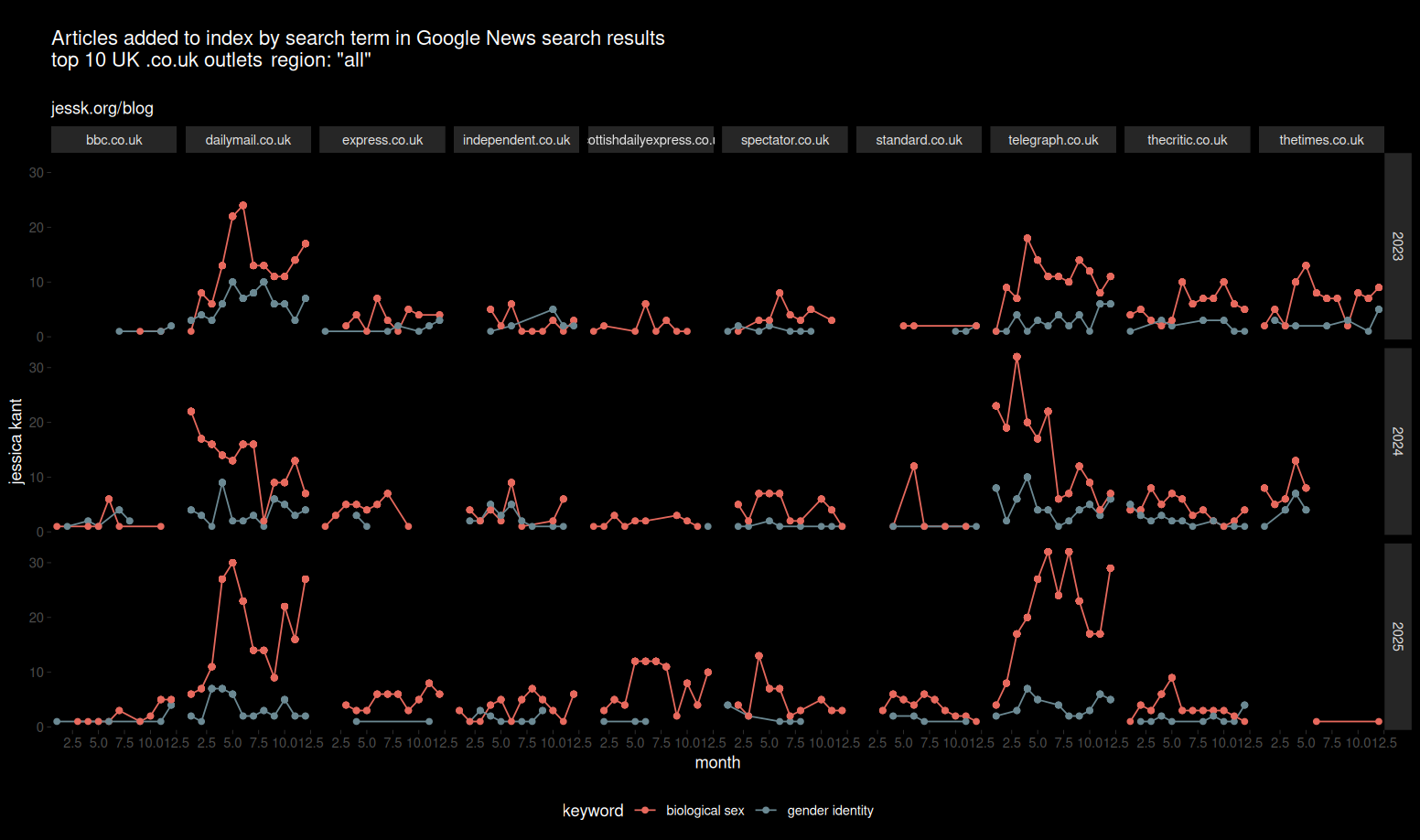
But in addition to the words used, the sheer volume continued to astonish as it did in 2024. Like Fox News in the US, the Daily Mail provided more coverage of trans people than any other outlet in the UK, followed only by the Telegraph— equally trans-hostile, and not shy about it. When Trump latched onto the phrase "gender ideology" in his EOs, it stood out as overtly eliminationist language. But popularized originally as an anti-feminism slogan by the Vatican, it became endemic in the UK in the past decade and has become arguably the most visible explicitly anti-trans term.
The asymmetry is astounding. Despite the widespread, undying claim to the contrary, mainstream news outlets produce news about trans people at a rate roughly a fifth of what the right-wing press churns out.
The Daily Mail has the distinction using the phrase “gender ideology” more than even “transgender”
While the post-mortem of the 2024 election endlessly cited the “Kamala is for they/them” attack ad as the tipping point, this elides the fact that even if this were said tipping point, it was only because not a single day passed from 2023 onward where Americans weren’t bombarded with articles about trans people that were at best negatively-valenced, at worst outright libel and incitement. By the time that particular match was lit, the entire United States had become a densely packed powder keg.
To create outrage, emphasize the absurd
While the images above show just a cross-section of some of the hundreds of thousands of observations captured by the scraper, they also show how any attempt at accuracy or veracity has gone completely out the window, with a chillingly familiar trend towards the bombastic that has led to pograms at other times in history.
Through every iteration of this series, I’ve stressed the crucial fact that extremism research shows people with prejudicial viewpoints tend, on average, to vastly overestimate the size of the groups towards which they hold such prejudices.There are other versions of this effect as well: confirmation bias, in which humans tend to equate how closely something aligns with their pre-existing views with its veracity, leads us to believe things even when we have significant reasons to doubt their truthfulness. When Trump claimed that children were having “sex changes” at schools, the fact that this is not only absurd but logistically impossible did little to stop the spread. It nevertheless made the rounds of conservative (and especially evangelical) social media at an astonishing rate, and pushed the boundaries of what was normal to claim within reason without sounding like you’ve lost all reason. That procedures which take full operating rooms, a dozen staff and as many hours in the OR, alongside week long admissions and months of healing could be done in the course of a school day without anyone being the wiser should have permanently burned the credibility of the world’s most notoriously dishonest man. But it was rhetorically useful, and because it was useful, it made it to print.
As it happens, it also made it to print in one of the darkly funniest op-eds ever written, excerpted here from the Portland Press Herald:
“I’m glad it’s come out that teachers are performing gender-altering surgeries at school. So much curriculum dumped on us, the scheduling, a logistical nightmare. We have team time – what many call “homeroom” – to work it in, 10 minutes a day. We’re expected to do three or four surgeries between American studies and AP physics and in our haste, we sometimes botch. The other day a girl came in as a girl and left as a girl. Embarrassing!”
Why did Josh Hawley claim this week in front of congree that “almost half” of all kids content on Netflix contained trans characters? While I think it’s equally plausible he made the number up out of thin air, it’s also true that over 200 Stories about Netflix and trans content appear in the dataset, despite the highest count I’ve been able to find of verifiable trans characters on Netflix kids shows being possibly 3 appearances in the past 5 years, with only one show featuring a trans cartoon protagonist. This last was summarily shut down after Elon Musk and Libs of Tiktok demanded a boycott via social media. Both posts were themselves served by Google News in the expanded dataset.
But pushing the absurd isn’t only good for outrage, because outrage isn’t only good for mobilizing a base. The absurd sells, and things that are both absurd and outrageous sell even when the most common form of discussion is ridiculing believers. This is how you get headlines like “Schools grooming kids, kid ‘litter boxes’, transgender and more” from radio station WIBX 950 AM/92.3 FM in Utica, New York. While much of the article is about a local superintendent pushing back on the absurdity of the discussion, the headline itself leaves the question open. However, evidence of how damaged the discussion had already become in January 2024 is replete through the short text. After 2023, the year “grooming” came back into popular parlance as an accusation against LGBTQ+ people and our allies, the scare quotes have dropped completely. Even amongst the debunking, the idea that adults might be trawling classrooms to recruit young people is treated like a serious question.
Why do conservatives believe that we’re everywhere, hiding in the bushes? Because powerful people won’t stop claiming it’s true, even if evidence to the contrary is everywhere.
To create fear, make them seem dangerous
Whereas prior to 2020, the majority of UK news about trans people focused on the UK, this has largely ceased to be true in the conservative press where articles about trans people generate a huge amount of revenue.
In November 2025, 16 months after the assassination attempt across the ocean in Pennsylvania, The Telegraph ran a story in the UK claiming that the alleged perpetrator, now deceased, “may have identified as nonbinary.” The claim appears to have originated in the US with Tucker Carlson, who claimed to have found secret social media accounts to verify the claim. This was, however, refuted by the FBI, who led the investigation. In response, the news media claimed that Trump’s own FBI was suppressing that information. The Daily Mail made a similar claim of conspiracy after the death of Charlie Kirk.
Technology has also accelerated this blurring of fiction, speculation, and fact. As I covered in posts about large language models, these fictive stories were so ubiquitous that several major chatbots attributed terrorist attacks and mass shootings to trans people long after the actual cisgender perpetrators were identified. As I’ve also covered previously, news aggregators had magnified this problem by creating duplicates not only of mainstream publications, but blogs and even social media posts. MSN’s news portal is automatically piped to every Windows computer on the planet simultaneously, with news alerts on start menus and push notifications displaying extremist websites alongside the Associated Press.
Yahoo! has also emerged as a major distributor of anti-trans hate. Like MSN, Yahoo! either struggles or doesn’t try to distinguish between factual or reputable outlets and tabloids, and serves as a laundering mechanism for the latter. Yahoo! also served content related to litter boxes, including a claim from the Scottish Sun that children were identifying with “species dysphoria”. As with most of MSN’s more disreputable entries, the article was eventually pruned from the database, but not before being logged by Google News, repackaged via Google’s index, and logged by the scraper. While it’s easy to dismiss this as moderation working as it should, the point of news indexes isn’t to preserve stories for posterity, but to distribute new content to intended audiences. In fact, news indexes get notoriously unreliable about serving content the older it is. What matters most is that for the short moment in time after an article is published, Microsoft, Yahoo, and Google bring them to the public who then share them on social media. A version of this particular article was also published in the Telegraph, and the Scottish Daily Express. The Times ran an op-ed strongly discouraging parents from encouraging this, despite the fact that the story in question wasn’t real in the first place.
Church Militant, whose crusader iconography and literal calls to arms was a focus of the first in this series, ultimately shut down in 2024 after losing a half-million dollar defamation lawsuit brought by a New Hampshire priest. But during its brief tenure on the news index for the duration of the data collection period, it was served 47 times as news. In April 2023, when the scraper counted 8 separate news articles, the website ran a piece that claimed Democrats in Minnesota had tried to “make pedophiles a protected class.” What had actually happened was that two unrelated clauses, one irrelevant, the other incendiary, had been removed as part of the normal legislative process. This became the basis for the obviously false claim that Gov. Walz signed a bill adding pedophiles to protections for LGBTQ+ Minnesotans. The old language had been added during a previous anti-gay moral panic at the height of the AIDS crisis in 1993 to assuage bigoted lawmakers who feared basic human rights protections would “legalize pedophilia”. Everything old is new again.
Entertainment over information
Obviously it isn’t groundbreaking to say that our news diets have been increasingly shaped by social media. Driven in part by mergers in technology companies and media outlets, news indices have increasingly started to display social media posts. When I first saw this, I assumed it was an error and checked the settings of each of the feeds which comprise the data input source. When that didn’t pan any results, I looked it up. Google has indeed begun intentionally showing video content in the news column, and they’ve recently streamlined the process of adding these manually to the index. While it’s slightly occluded when no region is specified, the feeds which were specifically looking at the United States show a meteoric rise just before the US presidential election, and hitting an all-time high just after the inauguration.
This makes sense: short form video content represents a growing proportion of the internet, and is the preferred social media style for people under the age of 30. It also presents a significant fact-checking problem, which is that searching inside video content is still in development and highly resource intensive.
Bombastic claims without citation are easier to make and harder to find on purpose, and what makes for viral content on YouTube is very different than its counterparts in the world of longform journalism. While Google claims that only the videos of verified news outlets will make it into the News index, this is demonstrably false. One such source is a relatively small channel with a video called “End harm wreaked by trans agenda”, which was served last year. However, “verified news outlets” haven’t shied from bombastic videos either. 108 of the observations recorded in 2025 from foxnews.com were video content. These included titles such as “Catholic schools have been 'hijacked,' 'corrupted by gender ideology”. That doesn’t include any local affiliates, either, which will be coming later. A single outlet, the one which happens to be the favorite of the president of the United States, can’t stop talking about us.
That’s the outrage factory.
Afterthoughts:
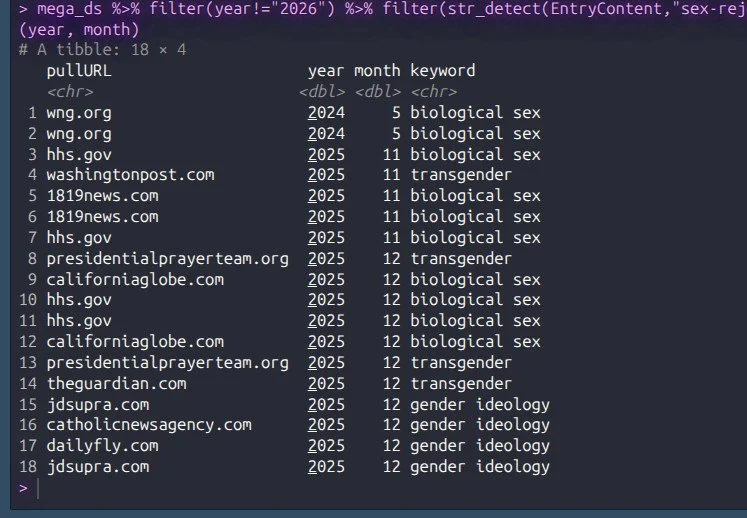
dplyr “tibble” summarizing distinct occurrences of the term in the entire 300MB corpus.
The day after the piece was published, Walter Bragman posted on Important Context a look into the origins of certain extremist terms that now make up the majority of federal language around gender-affirming care. Bragman note that the language of “sex-rejecting” which appeared in the past year in a series of executive orders and actions originated with the Ethics and Public Policy Center, a right-wing evangelical think tank which suggested the term in 2024 as an alternative to the accepted medical standard nomenclature of “gender-affirming”. Curious about this, I decided to run a quick query myself to see how this lined up with the news. The first hit, and only for 2024 for the Google News index is for May 2024, from the World News Group, an ultra-conservative news outlet. The page footer includes a “statement of faith” that makes their evangelical perspective quite explicit. These articles were released two days before the EPPC’s policy brief, to coincide with the launch. WNG’s article includes the stylized, bold pull-quote “gender-affirming care necessarily includes sex-rejecting harm.”
While there are many flaws in this data collection method, which I’ve been open about since the beginning as this was not originally intended as an academic work or even a long-term project, there are signficant strengths as well. Namely, that it records things as they are added, and in the cases of news portals like MSN, Yahoo!, and AOL (no really, that’s still a thing!), it captures what they resyndicate and post on their splash screens, even those portals themselves suspiciously delete the articles later in what I can only assume is a “once the damage is done” moderation strategy of sorts. Here, we can see a specific term emerge at the exact moment it’s pushed into the wild. It isn’t cold fusion, but it’s a start towards a more transparent news media.
Image credit: the factory photo in the background of the main image goes to Patrick Hendry at Unsplash. While it’s not super visible except in very large social media thumbnails, it gave the perfect feel I was looking for and I’m extremely grateful to him for making his work free to the public!
Usual data housekeeping points:
Given all the usual caveats about how Google processes pages with shoddy HTML that show unrelated stubs and therefore are captured in the index by accident, the majority of this analysis will focus on major media outlets whose appearance in the dataset can be relied upon to reflect an accurate positive hit. The design of the scraper uses multiple variables to account for idiosyncrasies in how Google returns news items from the index. Analyses therefore avoid combining regions and/or keywords, and to avoid artificially inflating the data. distinct() functions are used at points to filter out duplicates and near-duplicates.
