“What we choose to emphasize”
& The active process of enduring history
So much of my job these days is about figuring out how to find hope in a world that feels like it has none. When someone is sitting before you asking how they plan for a future they’re not sure will exist, it’s natural to want to reflexively assure them that emerging from crisis is a certainty. It also isn’t true. Which begs an essential question: what exactly is it that we’re trying to do while we sit here trying to hold up the sky?
This past Spring was one of the hardest times of my life, as it has been for so much of the country and world. While the summer has been equally full of chaos and violence, spring was exactly how far I’d made it into the second Trump administration without breaking in two. My body started to fall apart. I had panic attacks for the first time in I can’t possibly remember how long. I would throw up in the middle of the night. I would sit in front of air-conditioners on full blast, or name objects in the room out loud while pressing cold packs to my head and pounding Zofran and propanolol. And I would tell myself that I needed to just sit tight and wait.
Sometimes I would find myself telling my own therapist that I felt like I was treading water indefinitely, only certain that one day my body would give out. Maybe it’s seconds, maybe it’s years, maybe it’s decades, but every moment of the day people tell me that they are struggling to keep treading and they are all so painfully cognizant of the fact that they don’t have any control over their own ability to get out of the water. So what do we do down here among the icy waves?
The truth is, there’s a reason no one can remember anything lately, and everyone feels tired all the time.
When our means of survival and our sense of safety is shattered, our bodies register this not too dissimilarly from how we experience other types of violence. It puts us on constant high-alert, a state of hypervigilance. For people facing criminalization and death, the threats are obvious and terrifying. But so are threats to the means of survival via the necessities of life. We are all not far from catastrophe. As I was reminded recently in the emergency department struggling to breathe, it turns out the inhaler my insurance plan stopped covering, which costs hundreds of dollars a month and I’d assured myself was an expense I didn’t need, really does keep me alive.
But while threats to healthcare, housing, and the basic means of survival are a significant and rapidly increasing material reality for people in America, I often hear the most hopelessness from those at the margins of the cross-hairs. Those who are perhaps not comfortable, but to over-extend the metaphor: well above the waterline for now. They speak of looking around at those less fortunate, or under more direct threat from the machine right now and feeling a deep sense of shame. The shame often turns to denial. Or alcohol. Often both.
And all the while, the machine keeps plugging away, adding new horrors. Unspeakable crimes are everywhere on our screens.
There’s a reason people are thinking more about their mortality, and less about the life they want to build with whatever time they have left. Hopelessness changes how we see the future, and strips us of some of our most essential cognitive functions, including crucially the ability to project ourselves into the future. While human beings have rich inner lives which exist independent of the outside world, very little of our inside world remains unaffected by the latter.
There’s a growing body of literature that even from a cognitive perspective, it is our values that often afford us the only direction we have when we feel unmoored and lost. While this is central to Narrative Therapy, it is also central to third-wave models like Acceptance and Commitment Therapy (ACT). When your nervous system is flooded and we’re mired in decision fatigue, the first question isn’t necessarily what do we want to do, or even what are our options, but what is important to us in this given moment? Who do we want to be at this time in history? This may feel at first like a trap: after all, moral injury occurs most often in situations where participants are in some way not voluntarily a part of the horror.
But the antidote to moral injury doesn’t usually start with grand gestures, it starts with recognizing our capacity to act in the service of our values in small ways that remind us we have at least some agency, even if everything in us is screaming that we have none.
Our private lives and private suffering have a great deal to tell us about what we hold dear, even if those values are independent of the suffering itself. Michael White, one of the foundational thinkers in the world of Narrative Therapy wrote about this most intimately when describing therapeutic work with people who had survived sexual violence. He wrote about a conversation with a young woman in which traumatic dissociation was recast as an act of protest— a refusal to surrender the sanctity of her mind to the overwhelming violence she lacked the physical capacity to resist. I have never met her, but I think about her all the time.
When I can’t sleep and I’m in caretaking mode for myself because I realize I’ve been pushed harder and feel more exhausted than I ever have before, I remind myself to listen to Howard Zinn. There are so many people whose extraordinary work has changed and shaped who I am, but there is one person whose words have kept me afloat when I was certain I was drowning. It’s him, and more specifically, these words:
“What we choose to emphasize in this complex history will determine our lives. If we see only the worst, it destroys our capacity to do something. If we remember those times and places—and there are so many—where people have behaved magnificently, this gives us the energy to act, and at least the possibility of sending this spinning top of a world in a different direction.”
Our collective survival as a species right now will entirely depend on what we choose to emphasize. Not because of some sort of desperate attempt at positive psychology (I have never been accused of being overly positive), but because routes to resistance continuously feel otherwise wholly out of reach.
It’s easy to forget that resistance isn’t always a grand gesture, and throughout history men have been knocking on doors demanding papers and people, and all through history for all the people who have complied, there have been many who have stared blankly back and said they’d never heard of such a person.
My favorite story from the uprisings during the Arab Spring in 2011 and 2012 included a string of events where cab drivers drove obstructively and slowly, or even abandoned their cars despite the encroaching tanks to slow down regime soldiers. And as young people in Minneapolis reminded the world this week, it can be as simple as being told to move by a man with a gun and a badge and too much power, and still finding the internal fortitude to say “no” to him too.
So how do we operationalize this everyday resistance and turn it into something grander? While culturally we have appropriately emphasized the harm done by those who carry out unjust orders, we sometimes forget to celebrate the person who chooses not to. While we may recognize that the “bare minimum” of humanity requires us not to participate in evil, most of our lives within the structures of American society are built entirely on the free flowing of human suffering: the gas we burn, the carbon footprint from our livestock, the rare minerals and metals needed to power our phones. We participate passively all the time, and while it’s easy to imagine that were we faced with the right challenge at the right time we would rise to the occasion— the abundance of evidence is not necessarily clearly on our side. And this is why we need to be louder about our support for those who find their lines in the sand. Even, and especially, when those lines are drawn quietly and without fanfare.
Right now there are people everywhere whose daily lives put them in positions to either do great harm, or prevent it. People looking past obviously backdated rent checks because one more late payment could mean eviction for an undocumented family. People who are being told to take down pride flags and out LGBTQ+ students who choose to do neither. Maybe it’s the librarian who after being ordered to purge books about diversity leaves them on the shelf, or orders more. Maybe it’s the pharmacist in a deep red state who fills a vital prescription even though it’s also an abortifacient. No, these alone will not topple authoritarianism, but neither can authoritarianism survive if enough people refuse to participate.
Many years ago, a colleague told me about a young trans girl at a school with an ostensibly affirming policy on paper but several deeply anti-trans teachers. No students had complained, and only a portion even knew, but once they learned she was trans these teachers would follow her into the bathroom and make a scene. While it no doubt began as a single instance of one girl covering for another, over time the kids in her class developed an informal system of making sure someone was always on guard when she needed them. Was every student a part of this small underground resistance? No, probably not. But enough were that it made it possible for her to survive in an otherwise extremely hostile environment. Right now there are teachers across the country being told by a Department of Education that has made its entire raison detre the facilitation of discrimination that they, too, must become bathroom police.
And they too will face a choice — hopefully they’ll learn from their students.
We have so much cause for despair but perhaps we have even more reason to cling to those moments where despair abates, even if only for a moment. When over 100 clergy participant in nonviolent civil disobedience at Minneapolis — Saint Paul International airport on the same day that nearly a thousand businesses close in solidarity and more than 15,000 people out of a population of 429,000 turn up in subzero temperatures in defiance perhaps we have something to give us hope. And if not hope, maybe life?
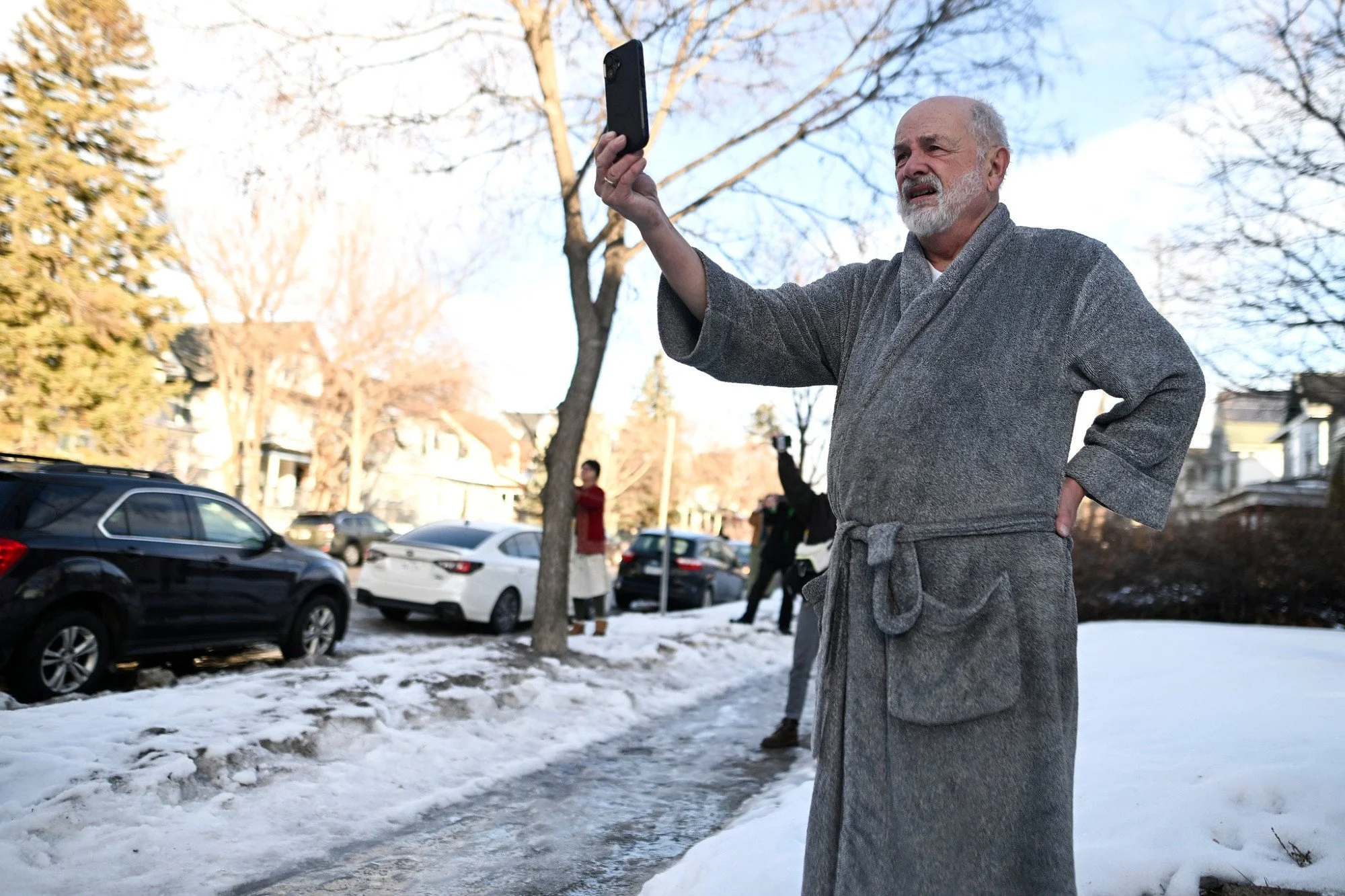
Photo: Stephen Maturen/Getty Images
Because long ago I adjusted my definition of hope away from a vision of a future where everything works out. To me, it’s about the belief that goodness still has the capacity to exist, and that we have the ability to conjure up this capacity if only we can shake off the paralysis. In Minnesota, the administration has threatened to imprison their elected officials, poured federal agents in full tactical gear into the city, dragged elderly men out of their houses, disappeared small children to detention facilities in the desert all while cutting off the state’s food assistance, childcare subsidies. And still, they showed up. A more accurate read is that they showed up because they saw all this with their own eyes, and were animated by their own values, their own ideals and their own humanity. When the most advanced deportation apparatus the world has ever seen is hamstrung at every turn by ordinary people in bathrobes, I will hold onto this like oxygen.
Epilogue: surviving the pendulum
Last night, late into the early morning I watched Andor, Season 2 again. After all, so much of this post was inspired in truth by Nemik’s statement about the imperial thought machine. Electrified from the livestreams, I didn’t want to shake off the feeling. But as the season dragged on, so did the state violence. And so did the uneasy fear. Andor is gripping because it tells the story of a people we know in our heads, even as we attempt to suspend this knowledge, do not see the rebellion they began come to fruition (not a spoiler, rather premise of the show). But maybe that’s the appeal?
Because as much as people tell me about the treading water, they also tell me all the time that it feels like their moods have been attached to erratic pendulums which swing wildly moment to moment. And the higher the high, the more gripping the low, which whatever the focus is nearly always marinating in a deep sense of dread.
Today as I scrolled through images from yesterday, the news came on that another man had been murdered.
But also right now, people are amassing throughout the Twin Cities yet again. Neighbors are checking in on neighbors just like they did the day before and the day before that. And despite what they did to Renee Good, at the scene of the murder today a woman in a pink coat with a camera captured it all. She didn’t move or run, and she kept filming even as weapons were drawn. Whoever she is and whatever her motive, today she made the terrifying decision to be a witness.
During the first administration, when people would ask me about burnout doing solidarity work with prisoners and immigrants in detention, I would half-joke that I was “unecumbered by hope”. And while it was a fun thing to say when my mental health was in the toilet and I had no better answer, there is a wisdom to that which I’ve been trying to rescue in my own therapy.
The more I live in relationship to anxiety and fear, the more clear it becomes that so much of what grinds us as people to a halt is our focus on the things over which we have no control. There’s nothing new there— it’s a central premise in addiction recovery. If we focus on the ways in which we are powerless, if we focus on calculating the odds to an uncertain and dangerous future, it “destroys our capacity to do something” per Zinn. But we have to do something, and if we can’t figure out what our options are, then perhaps we must again reconnect with who we want to be in this moment.
At least speaking for myself, I don’t have a grand design for the future, I don’t even know if we’ll survive much longer as a species into the anthropocene. But I know that when the apocalypse comes, I want to be able to say that I took at least some steps, no matter how small, to stop the end of the world.
They are never, ever going to win in Minnesota.
— Christopher Terry (@christopherterry.bsky.social) January 23, 2026 at 3:56 PM
[image or embed]
“And if we do act, in however small a way, we don’t have to wait for some grand utopian future. The future is an infinite succession of presents, and to live now as we think human beings should live, in defiance of all that is bad around us, is itself a marvelous victory.”
— Howard Zinn
I wrote the following resources many years ago to have something to give to people who wanted to understand their trauma symptoms. This grew to include guides on grounding, the history of the psychology of trauma, and why deep breathing doesn’t work for everyone and how to adjust for your own body’s needs.
If you need to talk to someone right away, please check out this directory from the American Psychological Association, or call or text 988.
If you are looking for a therapist, please consider looking first at sites which vet their therapists. Unlike Psychology Today, which sells its verification based on cost alone, directories like Zencare do live screening with prospective providers.
