pertussis, measles & the cost of anti-vaccine fear

In the year 2000, the Centers for Disease Control (CDC) announced that measles, a deadly and highly infectious disease which disproportionately harms children, was successfully declared eliminated. Twenty five years later, that status stands to be revoked.
While between 2000-2019, only 3,873 cases of measles were reported in the US, 1,798 had been reported as of November 25th in 2025 alone.
On November 10th, the Canadian Public Health agency made the announcement that Canada’s measles elimination status was officially revoked, 27 years after the virus was declared eliminated in the country. The United States will soon follow. By Spring of this year, more new measles cases had been reported in the state of Texas in 2025 than in all of the continental United States over the preceding five years in aggregate. That’s a startling jump.
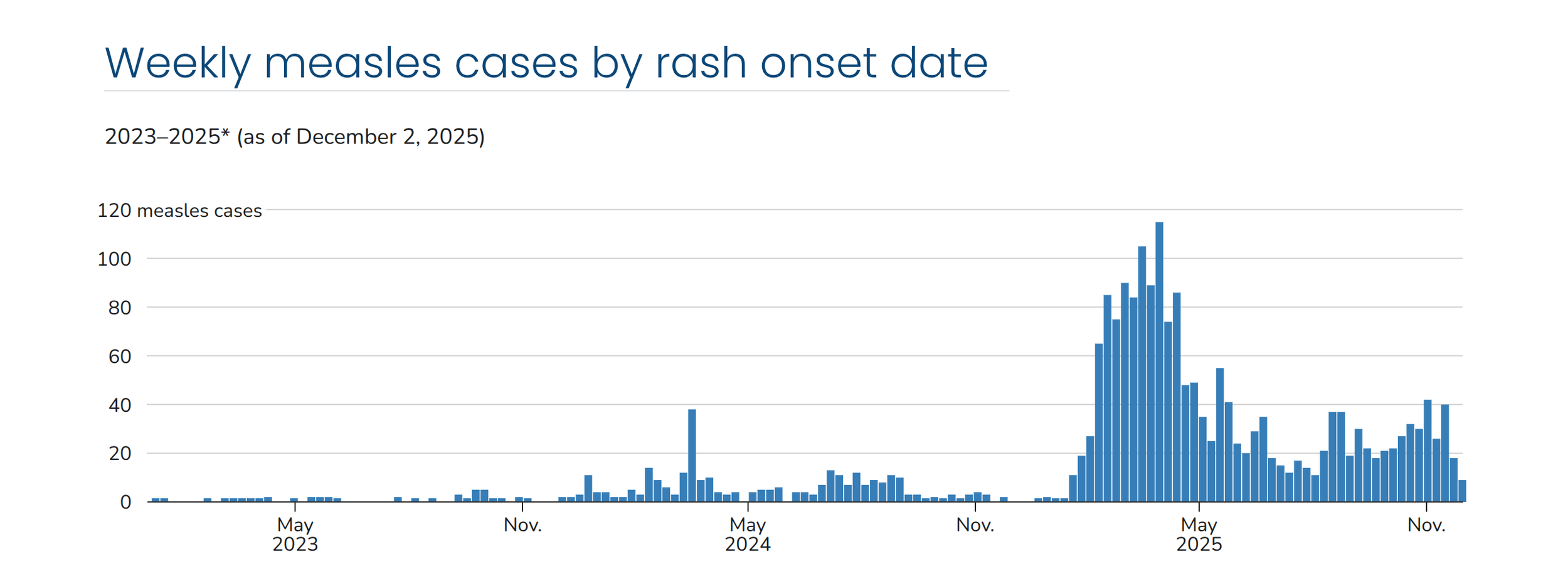
In total, 2024 saw as many as 35,435 verified cases, quintupled from 7,063 in 2023.
Source: Centers for Disease Control
But you wouldn’t know it from looking at where the Centers for Disease Control has been focusing its efforts as of late. In October, 1,300 employees were laid off following the government shutdown, leaving the agency “Not functional” according to Time Magazine, who interviewed employees. Among those impacted were the staff of the Morbidity and Mortality Weekly Report (MMWR), a public health surveillance tool crucial for reporting on trends in near real-time. Experts were fired and then rehired almost immediately, but dramatic changes have been made to what information is available to the public. At the end of October, the news portion of the journal Science announced that a leaked draft of the HHS budget no longer contained funding for the publication of Preventing Chronic Disease and Emerging Infectious Diseases. Across the country this mirrors instability seen in local departments of public health, as politicians reshape priorities and take positions that go against the consensus of the broader field. This has occurred alongside bizarre delays in data publication or its absence. Significant concerns exist about US infectious disease data. Therefore, while we have clear signs of concern, we also have reason to wonder if there isn’t more — or where we are going.
In the past, we’ve seen that COVID-19 cases were initially dramatically undercounted even while the opposite was suggested at the time. Whether this was a failure of surveillance or the natural consequence of Trump’s famous suggestion that “If we stop testing right now, we’d have very few cases, if any” is less clear. However, if we take to heart the lesson that we rarely know of all cases of a disease until far in retrospect, we might be much more concerned about already substantially alarming data.
Over the past two years, pertussis has seen a deeply concerning rise as well. Whooping cough, as it’s more commonly known, was once one of the deadlier common childhood diseases with hundreds of thousands of cases a year through the 1940’s, when vaccination against the illness became commonly available. The infection and resulting disease is deeply painful, with cases of infants coughing so hard they suffered rib fractures as a result. People infected with the illness report coughing so hard they vomit, passing out breathless, or coughing up blood. Such outcomes aren’t restricted to very young children, either. In 2024 the case report for a 48-year-old woman who suffered a rib fracture was published in the journal BMC Infectious Diseases. The authors note the patient lacked any known underlying respiratory conditions such as asthma or lung disease, and was a non-smoker. It is known as the “100 day cough.”
It’s not difficult to find where to place the blame. Children are regularly vaccinated against both measles (MMR) and pertussis (DTaP/Tdap), and most school districts require vaccination for enrollment. As anti-vaccine conspiracy theories have become popularized, so too have processes for exempting children from mandatory vaccination. While this may at first only seem likely to be used by a small portion of the population, it will only take a very small portion of the population to bring us below the necessary population immunity to control the spread.
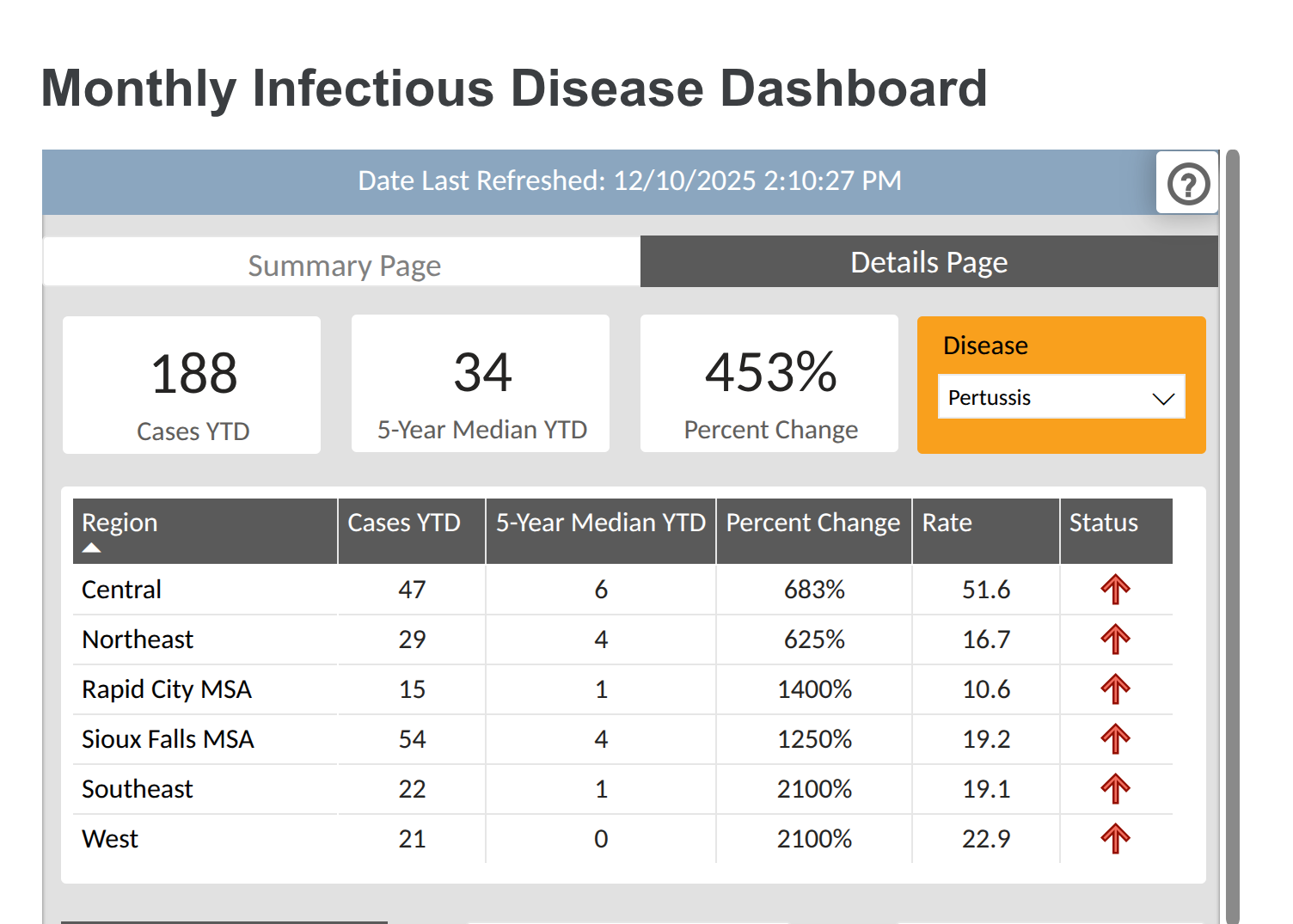
Having plummeted to less than ten thousand cases a year during the height of the initial COVID-19 pandemic from 2020-2024, alarms were raised last year when the CDC reported preliminary pertussis data had surpassed six times the previous year by October. In total, 2024 saw as many as 35,435 verified cases, which quintupled from just 7,063 in 2023. 2025 remains dangerously elevated with unusually high cases being reported in Texas, Louisiana, Oregon, South Carolina, South Dakota, Kentucky, Utah, West Virginia and Washington state. Oregon has already reported the most cases of whooping cough this year since 1950. This week, a school district in Iowa cancelled school due to an outbreak.
Louisiana has received particular attention after it emerged that the state delayed notifying the public of a whooping cough outbreak months after two infants died from the disease in early 2025. This was shortly followed by a directive to end vaccination recommendations across the state by the surgeon general, recently tapped to be the deputy director of the CDC by the Trump administration. While Louisiana’s leadership makes the transition to the helm of one of the most important infectious disease-fighting agencies in the country, West Virginia is responding to their own pertussis outbreak with a similarly worrying shift. Officials have suspended school vaccination mandates following a judge’s decision in favor of broad religious exemptions. This occurred after the governor enacted religious exemptions mid-January by executive order. Previously, West Virginia had famously strict vaccination policies.
Kentucky recently reported the third such death, as the University of Minnesota’s CIDRAP reports. CIDRAP and the Kentucky Department of Public Health note the last time someone died from pertussis in the state before 2025 was in 2018. The current level is the highest the state has seen in a decade. Texas, meanwhile, is seeing the highest pertussis levels in over a decade as well, having already recorded more than 3,500 cases. This is twice the number of cases reported in 2024 (four times the number for the same period), and ten times the number of cases reported in 2023. And yet again, politicians are attempting to decrease vaccination rates for totally cynical reasons by implementing more exemptions.

Source: Florida Department of Health
While Florida’s surgeon general calls for people to report “vaccine coercion”, the state is currently reporting 1,454 cases as of December 11, 2025. 715 cases were reported in the state last year, making this year’s count more than double previous year.
The frame of vaccination as a “personal choice” elides the extremely important fact that the effectiveness of public vaccination programs relies on high rates of vaccine uptake for herd immunity. These thresholds, typically between 90-95% of the population depending on the specific disease, are the bar under which contagions can spread much more easily within communities. For pertussis, this is 92-94%.
For measles, which requires 95% vaccination, we have already fallen below this crucial line, as Claire Cameron for Scientific American reports:
“The state has seen vaccination rates of its schools’ students decline from almost 96% in 2020 to 93.5% in 2025—for context, robust herd immunity from measles requires about 95% of the population to be vaccinated, according to the WHO”
This is especially important for immunocomproimised people, or those who cannot be vaccinated. Pertussis provides an important example of this. Despite the DTaP (Diphtheria, Tetanus & Pertussis) vaccine guidelines being recommended for very young children, infants under 2 months remain susceptible. To prevent vertical transmission (infection passed by mothers/gestational parents to newborns), pregnant people are able to be vaccinated — despite widespread belief to the contrary. However, this is far from the only means of transmission. Very young children around other unvaccinated very young children can easily contract the virus. Research shows that 80% of unvaccinated people who come into contact with the infection will contract the disease. When people make the “personal choice” not to vaccinate, they are not only making a personal choice to allow themselves to become susceptible to infection, they’re making a choice to do so with the higher-than-not likelihood that they will pass a pathogen on to another human being.
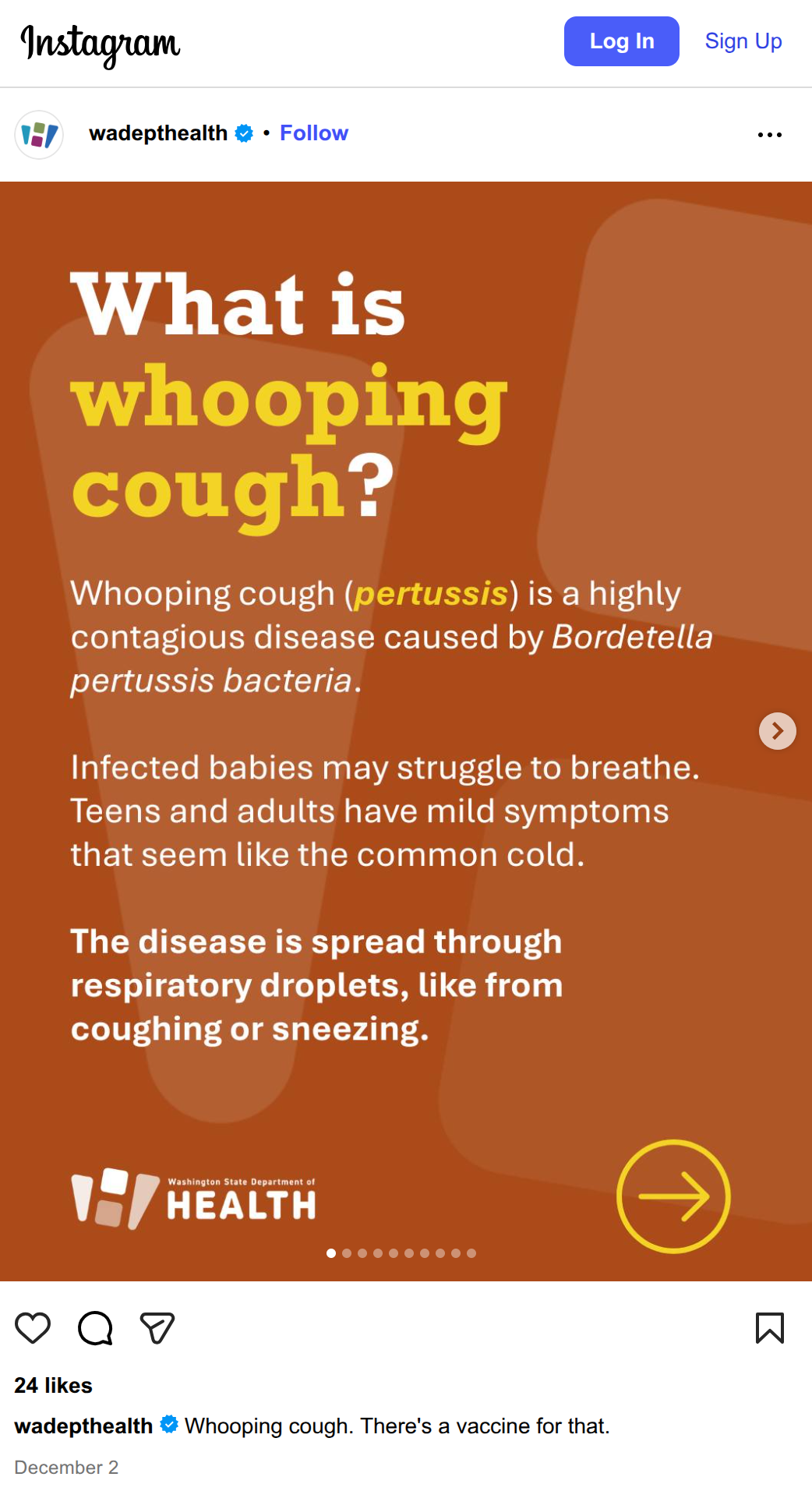
Source: Instagram
Not every state is following this dangerous trend. While preliminary data out of Washington suggests that the case count for pertussis will be higher in 2025 than 2024, a figure from the Washington State Department of Health’s weekly pertussis update shows what appears to be a decline from the start of the year to now, where the reverse was true in 2024.
Last year, as cases climbed, state health officials were unified in urging residents to vaccinate and took to social media to raise awareness of the surge as a public health crisis. Washington has also released several statements refuting claims around autism and vaccination safety, addressing vaccine misinformation directly. While raw data alone can’t tell us for sure which efforts are working, the contrast between Washington and Florida is a striking one. This is not to say Washington hasn’t been hit, and hard:
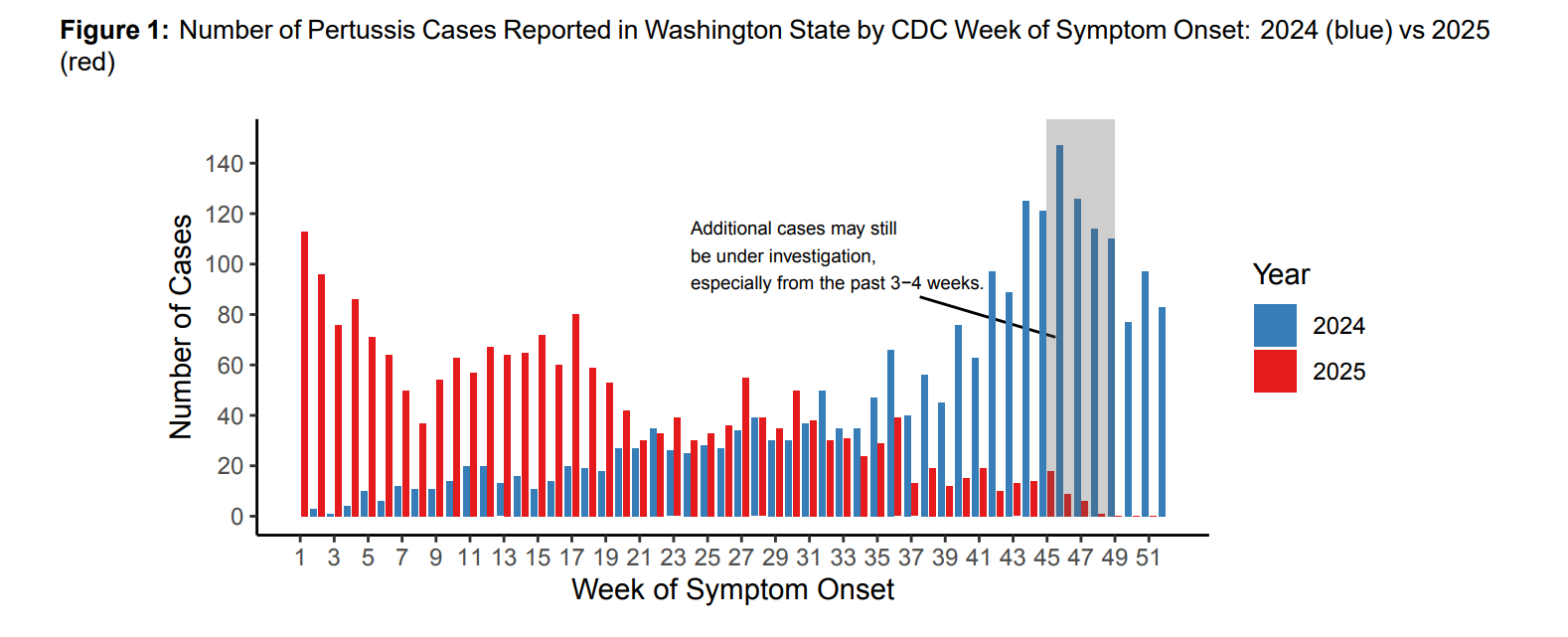
“As of May 31, more than 1,300 cases have already been reported statewide in 2025. The state also noted its first whooping cough-related death in 2024, the first since 2011.” (Source: NBC)
Image source: Washington State Deptartment. of Health
One method for drumming up public support for such a dangerous policy has been to change the criteria upon which “safety” is determined. The decision to implement vaccine policies should be based on specific criteria which are widely agreed upon by real experts in the field of epidemiology. This is why elevating people totally outside of their given fields has been so crucial to the larger project of disrupting and dismantling science for political gains.
Many professional organizations, like the American Medical Association and the American Association of Public Health (APHA) have raised the alarm about scientists and physicians being oustered in favor of politically useful functionaries, such as the replacement of Dr. Susan Monarez, a microbiologist and public health expert who was sworn in as director of the CDC only to be fired within a month without clear reason. In her wake, silicon valley investor Jim O’Neill was sworn in as acting director. His bio on the CDC website is predictably blank. One of his actions as leader has been to call for the delivery of MMR vaccines separately, turning 1 shot into 3. This is counter to most public health wisdom: we bundle vaccines together to raise uptake across the board. When forced to get them separately, uptake rates tend to decline as people select which illnesses they’re most concerned about at a given time. This can open up new pockets of undervaccination.
In several key areas, from mifeprestone and hormonal birth control to gender-affirming care and vaccination, the most influential decision-makers are no longer scientists. In posts previously occupied exclusively by physicians, we now see attorneys, businessmen, philosophy professors, and even economists. This has allowed them to make bold claims about evidence and safety by changing which variables to prioritize in analysis. When things happen like a “supply chain expert” is put in charge of pediatric vaccine schedules, we must ask questions about why this happened. It also means that the facts and figures most frequently cited to the public are no longer rising infection rates and dropping vaccination rates. Instead the focus is now vaccine adverse events, or cases in which someone has claimed vaccines were responsible for such deaths, even in the absence of any medical evidence. This also means that even when the numbers don’t disappear, the ones which do matter are de-emphasized to attempt to force discursive irrelevance of clear data indicating policy failure.
But as Dr. Alyssa Kuban points out on the American Medical Association’s infectious disease blog, focusing on rare side effects obscures much more important data points. Pertussis is very dangerous at a population scale, especially to children under 6. Every person who is medically safe to do so should be running to vaccinate if they haven’t already, if for no other reason than the care and protection of children and vulnerable people. This is what a just society does: takes reasonable steps to protect one another. That's the social contract we all should live by.
“The one thing I point out is that, for children under 6 months, the mortality rate is 1%,” she said, emphasizing that “if there is an outbreak where 100 babies have pertussis, one in 100 would die.”
Focusing the conversation on a small number of severe outcomes allows them to obscure the much greater cumulative burden of disease which is threatened by their policies. While the mortality rate is lower for measles, the lifelong burden of disease is not small. Measles can cause what is known as “immune amnesia”, where the antibody information for past infections is lost and the body becomes susceptible to infections again. Someone who recovers from measles may be re-infected by something to which they had previously developed immunity either through infection or immunization. The body becomes naive to a range of illnesses it has already survived. Measles also has a shockingly high rate of leaving infected patients blind or suffering from other debilitating conditions which can tremendously alter the course of someone’s life. It is not something to take lightly, and the fact that there are multiple deadly diseases we had once all but eliminated sweeping the globe and not a single person in Washington, DC has done a press conference about it should be evidence enough that there is an agenda at play which has very little interest in making us healthy.
